The perfect pour over coffee ratio is 1:16, meaning one gram of coffee for every 16 grams of water, or approximately 2 tablespoons of coffee per 8 ounces of water. This ratio delivers balanced extraction and optimal flavor for most coffee preferences. Understanding how to measure and adjust this ratio will transform your daily brewing routine, ensuring consistent, delicious pour over coffee every single time you brew at home.
Understanding the Golden Pour Over Coffee Ratio
The standard pour over ratio of 1:16 has become the industry benchmark in 2026 because it creates the ideal balance between strength and clarity. When you use this ratio, you extract approximately 18-22% of the coffee’s soluble compounds, which falls within the Specialty Coffee Association’s optimal brewing parameters. This ratio works exceptionally well with medium roast coffees and produces a clean, balanced cup that highlights the coffee’s natural characteristics without overwhelming bitterness or weak flavor.
However, the 1:16 ratio serves as a starting point rather than an absolute rule. Your personal taste preferences, coffee origin, roast level, and brewing device all influence the ideal coffee-to-water ratio for your situation. Lighter roasts often benefit from a slightly tighter ratio like 1:15, while darker roasts may taste better at 1:17. The key is understanding this baseline so you can make informed adjustments based on your specific needs and taste preferences.
How Many Tablespoons of Coffee for Different Serving Sizes
Converting the gram-based ratio to tablespoons makes pour over brewing more accessible for home brewers without digital scales. One tablespoon of whole bean coffee weighs approximately 5-7 grams depending on the bean density and roast level, with an average of 6 grams per tablespoon. This means you’ll need roughly 2 tablespoons of coffee for every 8 ounces of water to maintain the 1:16 ratio.
Coffee Measurements for 8 to 16 Ounces
For an 8-ounce pour over, use 2 tablespoons or 12 grams of coffee with 237 ml of water. This single-cup serving is perfect for morning routines and provides a standard coffee shop size. For a 12-ounce pour over, increase to 3 tablespoons or 18 grams of coffee with 355 ml of water, which creates a generous mug-sized serving ideal for leisurely weekend mornings or when you need extra caffeine.
The popular 16-ounce pour over requires 4 tablespoons or 24 grams of coffee with 473 ml of water. This larger serving size has gained popularity in 2026 as remote work continues and people brew larger single servings instead of making multiple smaller cups. These measurements maintain the optimal extraction regardless of serving size, ensuring consistency across different volumes.
Larger Batch Measurements for 20 to 32 Ounces
For a 20-ounce pour over, measure 5 tablespoons or 30 grams of coffee with 591 ml of water. This size works well for sharing or when you want coffee throughout your morning without rebrewing. A 24-ounce batch needs 6 tablespoons or 36 grams of coffee with 710 ml of water, perfect for two standard 12-ounce servings.
The 32-ounce pour over requires 8 tablespoons or 48 grams of coffee with 946 ml of water. This larger batch size is ideal for households with multiple coffee drinkers or for meal prep enthusiasts who want to cold brew concentrate using pour over techniques. Remember that larger batches may require adjusted bloom times and pouring techniques to ensure even extraction across all the grounds.
How Much Coffee for 500ml Pour Over
For a 500ml pour over, you need 31 grams of coffee or approximately 5 tablespoons to maintain the 1:16 ratio. This metric measurement is particularly popular in 2026 as more American coffee enthusiasts adopt international brewing standards. The 500ml serving size produces roughly 17 ounces of finished coffee, accounting for the small amount of water retained by the grounds during brewing.
This volume has become increasingly common because it fits perfectly with standard Chemex 6-cup brewers and medium-sized V60 drippers. When brewing 500ml, use a medium-fine grind similar to sea salt texture, and aim for a total brew time of 3 to 3.5 minutes. Start with a 50-gram bloom using twice the weight of your coffee grounds, then pour the remaining 450ml in circular motions over the next 2.5 minutes for optimal extraction and flavor clarity.
How Many Scoops of Coffee for Pour Over Brewing
Coffee scoops vary significantly in size, but standard coffee scoops hold approximately 2 tablespoons or 10-12 grams of whole bean coffee. For an 8-ounce pour over, one level scoop provides the right amount. For 16 ounces, use two level scoops. This scoop-based measurement system works well for consistent daily brewing when you use the same scoop each time.
However, scoops introduce more variability than scales because coffee density changes with roast level and bean origin. A light roast Ethiopian coffee may weigh less per scoop than a dark roast Brazilian blend, even with identical volumes. For the most consistent results, invest in a simple digital scale that measures in 0.1-gram increments. These scales cost $15-25 in 2026 and eliminate guesswork from your pour over coffee measurements, ensuring perfect ratios every time.
Adjusting Your Pour Over Ratio for Taste Preferences
The 1:16 ratio produces a medium-strength coffee that most people find balanced and enjoyable, but personal preferences vary widely. If your coffee tastes too weak or watery, tighten the ratio to 1:15 by adding more coffee or using less water. If the coffee tastes too strong, bitter, or overwhelming, loosen the ratio to 1:17 by reducing coffee or increasing water. These small adjustments make significant differences in the final cup.
Stronger Coffee Ratios for Bold Preferences
Coffee drinkers who prefer stronger, more intense coffee should start with a 1:15 ratio, using approximately 2.2 tablespoons per 8 ounces or 16 grams of coffee for 240ml of water. Some specialty coffee enthusiasts even use 1:14 ratios for particularly bold brews. These tighter ratios work especially well with light and medium roasts that have more delicate flavor profiles requiring higher coffee concentrations to shine through.
When using stronger ratios, pay attention to extraction quality. Adding more coffee without adjusting grind size or brew time can lead to over-extraction and bitterness. Consider using a slightly coarser grind and maintaining the same brew time to balance the increased coffee amount. This approach delivers strength without harsh flavors, creating a robust yet smooth cup.
Lighter Coffee Ratios for Delicate Brews
For lighter, more delicate coffee, try a 1:17 or even 1:18 ratio by using approximately 1.8 tablespoons per 8 ounces or 14 grams of coffee for 240ml of water. These looser ratios work beautifully with dark roasts that already have intense flavors, allowing the coffee’s subtle notes to emerge without overwhelming bitterness. Many Japanese kissaten-style coffee shops use ratios as light as 1:20 for their signature clean, tea-like brews.
Lighter ratios require attention to water temperature and pour technique. Use water at 200-205°F rather than the standard 195-200°F to ensure adequate extraction despite the lower coffee concentration. Pour more slowly and deliberately to maximize contact time between water and grounds, compensating for the reduced coffee amount with improved extraction efficiency.
Essential Pour Over Equipment for Accurate Measurements
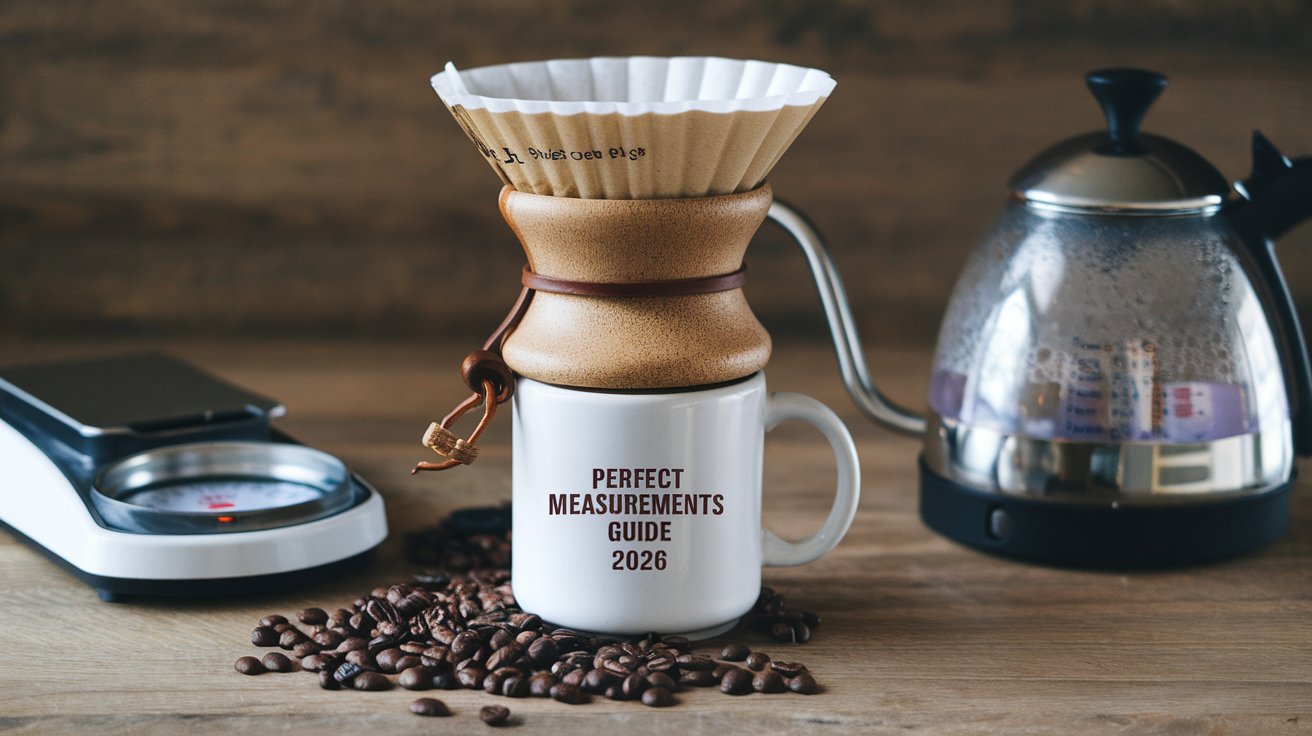
Achieving the perfect pour over ratio consistently requires proper measuring equipment. A digital scale with 0.1-gram precision and a built-in timer has become the single most important tool for home pour over brewing in 2026. Leading brands like Hario, Acaia, and Brewista offer models ranging from $25 to $250, with excellent mid-range options around $50 that include Bluetooth connectivity and brewing apps.
Beyond scales, your grinder significantly impacts ratio consistency. Burr grinders produce uniform particle sizes that extract evenly, making your ratio more predictable and reliable. Blade grinders create uneven particles that extract at different rates, making it nearly impossible to dial in the perfect ratio. In 2026, quality burr grinders start around $80 for manual models and $150 for electric versions, representing essential investments for serious pour over enthusiasts.
Pour Over Brewing Devices and Their Ideal Ratios
Different pour over devices work optimally with specific ratios. The Hario V60 excels with the standard 1:16 ratio due to its fast flow rate and 60-degree angle. The Kalita Wave’s flat bottom design works beautifully with 1:15 to 1:16 ratios, providing consistent extractions. The Chemex, with its thicker filters and slower flow, often tastes best with slightly looser 1:16 to 1:17 ratios that prevent over-extraction.
The Clever Dripper and similar immersion pour overs benefit from tighter 1:14 to 1:15 ratios because their steeping method extracts differently than percolation devices. The Fellow Stagg XF, released in 2024, uses a unique double-wall filter design that works optimally at 1:15.5 ratio. Understanding your device’s characteristics helps you optimize the coffee-to-water ratio for your specific brewing setup.
Kettles and Water Temperature Control
A gooseneck kettle with temperature control ensures you can maintain the precise water temperature required for optimal extraction at your chosen ratio. Variable temperature electric kettles from Bonavita, Fellow, and Brewista allow you to set exact temperatures between 140°F and 212°F. For most pour over brewing at 1:16 ratio, 200-205°F produces excellent results with medium roasts.
The gooseneck spout provides precise pouring control essential for even saturation and consistent extraction. When you pour too quickly or unevenly, some grounds over-extract while others under-extract, making your carefully measured ratio less effective. A proper gooseneck kettle costs $40-180 in 2026, with excellent mid-range options around $80 that include temperature displays and 30-minute hold functions for brewing multiple cups.
Step-by-Step Pour Over Process with Perfect Ratios
Begin by heating your water to 200-205°F while weighing your coffee beans. For a 16-ounce pour over, measure 24 grams of whole beans. Grind the coffee to a medium-fine consistency resembling sea salt, completing the grind just before brewing to maximize freshness. Place your dripper on a carafe or mug, insert a filter, and position everything on your scale. Tare the scale to zero.
Rinse the filter with hot water to remove paper taste and preheat your brewing vessel. Discard the rinse water, add your ground coffee to the filter, and create a small well in the center of the grounds. Tare your scale again to zero. This preparation ensures accurate measurements and optimal brewing temperature throughout the process, setting the foundation for excellent extraction at your chosen ratio.
Blooming the Coffee Grounds Properly
Start your timer and pour twice the weight of your coffee in water for the bloom phase. For 24 grams of coffee, pour 48 grams of water in a spiral motion starting from the center and moving outward, ensuring all grounds are saturated. The bloom releases carbon dioxide trapped in the coffee, which can block water from extracting flavor compounds if not released first.
Allow the coffee to bloom for 30-45 seconds, watching for bubbling and expansion. Freshly roasted coffee produces more vigorous blooms than older coffee, with peak bloom occurring 3-14 days after roasting. After the bloom period, you’ll pour the remaining water to reach your target ratio. For a 16-ounce brew at 1:16 ratio with 24 grams of coffee, you’ll add 336 more grams of water after the initial 48-gram bloom.
The Main Pour Technique for Even Extraction
After blooming, begin the main pour by adding water in a steady, circular motion, maintaining the water level about halfway up the coffee bed. Pour in stages of 80-100 grams, allowing the water to drain slightly between pours. This pulsing technique prevents channeling and ensures even extraction across all grounds, maximizing the effectiveness of your carefully measured ratio.
Complete your pours by 2:30-3:00 on your timer, then allow the remaining water to drain completely. Total brew time should reach 3:00-3:30 for most pour overs. If your brew finishes too quickly, grind finer or pour more slowly. If it takes too long, grind coarser or pour faster. These adjustments help you maintain optimal extraction even as you experiment with different ratios and coffee varieties.
Common Pour Over Ratio Mistakes and Solutions
The most common mistake is measuring by volume instead of weight, which introduces significant inconsistency. Coffee beans vary in density, so tablespoon measurements can differ by 2-3 grams between different origins and roast levels. This variation represents 15-25% of your total coffee amount in an 8-ounce brew, drastically affecting flavor. Always use a scale when possible, or at least use the same measuring scoop with the same coffee for consistency.
Another frequent error is forgetting to account for water retained by the grounds. Coffee absorbs approximately twice its weight in water during brewing. If you use 24 grams of coffee for a 16-ounce brew, the grounds will retain about 48 grams of water, leaving you with approximately 14.3 ounces of finished coffee. To get exactly 16 ounces, start with 432 grams of water instead of 384 grams, compensating for absorption.
Fixing Bitter or Sour Pour Over Coffee
If your pour over tastes bitter, harsh, or astringent, you’re likely over-extracting the coffee. This happens when too much water contacts the grounds for too long, pulling out undesirable compounds. Try using a coarser grind, reducing brew time, lowering water temperature to 195-200°F, or loosening your ratio to 1:17. Over-extraction often occurs with dark roasts that already have pronounced bitter notes.
Conversely, sour or weak coffee indicates under-extraction. The water hasn’t pulled enough flavor compounds from the grounds, leaving you with thin, acidic coffee. Solutions include grinding finer, increasing brew time, raising water temperature to 205°F, or tightening your ratio to 1:15. Under-extraction frequently happens with light roasts that require more aggressive extraction to access their complex flavor profiles.
Inconsistent Results and How to Improve
Inconsistent pour over results usually stem from variable measuring techniques or old coffee. Coffee begins losing flavor complexity within days of roasting, with significant degradation after 2-3 weeks. Purchase coffee roasted within the past two weeks and store it in an airtight container away from light and heat. Use it within three weeks of the roast date for optimal results with your calculated ratios.
Water quality also impacts consistency significantly. Use filtered water with 75-150 ppm total dissolved solids for best results. Distilled water lacks minerals needed for proper extraction, while hard water over 200 ppm can muddy flavors and create scale buildup. Third Wave Water and similar products offer mineral packets that optimize regular filtered water for coffee brewing, ensuring your perfect ratio translates into consistently excellent cups throughout 2026.
Advanced Ratio Techniques for Coffee Enthusiasts
Experienced pour over brewers often employ ratio manipulation throughout the brewing process rather than using a single consistent ratio. The bypass method involves using a tighter ratio like 1:12 for the initial brew, then diluting the concentrated coffee with additional hot water to reach the desired strength. This technique can produce cleaner, brighter cups by reducing the contact time between water and grounds.
Another advanced approach involves adjusting ratios based on coffee age. Very fresh coffee (3-7 days post-roast) often tastes better with looser ratios around 1:17 because the beans still contain significant carbon dioxide that affects extraction. Coffee in the sweet spot (8-14 days post-roast) works perfectly at 1:16. Older coffee (15-21 days post-roast) may benefit from tighter 1:15 ratios to compensate for declining flavor compounds and reduced carbon dioxide interference.
Regional and Cultural Pour Over Ratio Variations
Japanese kissaten coffee culture traditionally uses lighter ratios between 1:18 and 1:20, producing delicate, tea-like coffee with remarkable clarity. This style emphasizes subtle flavor notes and pairs beautifully with light roasts from Ethiopia, Kenya, and Colombia. The longer, more deliberate pour technique used in kissaten brewing compensates for the lighter ratio by maximizing extraction efficiency through extended contact time.
Scandinavian coffee culture, particularly in Norway and Sweden, prefers lighter ratios around 1:17 to 1:18 combined with very light roasts that would seem under-roasted by American standards. This approach creates bright, fruit-forward coffee with wine-like acidity. In contrast, Italian coffee traditions favor much tighter ratios closer to 1:10 or 1:12 for espresso-based drinks, though pour over brewing is less common in Italian coffee culture. Understanding these cultural preferences helps you explore different ratio territories based on established brewing traditions.
Related video about pour over coffee ratio
This video complements the article information with a practical visual demonstration.
What you should know
How many tablespoons of coffee for 16 oz of pour over?
For a 16-ounce pour over, use 4 tablespoons or 24 grams of coffee with 473 ml of water. This maintains the standard 1:16 coffee-to-water ratio that produces balanced, flavorful coffee. Each tablespoon of whole bean coffee weighs approximately 6 grams, so 4 tablespoons provide the right amount for this serving size. If you prefer stronger coffee, increase to 4.5 tablespoons, or decrease to 3.5 tablespoons for lighter coffee. Using a digital scale ensures the most consistent results across different coffee varieties and roast levels.
How to make a 12 oz pour over coffee?
To make a 12-ounce pour over, measure 18 grams of coffee (3 tablespoons) and grind to medium-fine consistency. Heat 355 ml of water to 200-205°F. Place a rinsed filter in your dripper, add grounds, and create a small well in the center. Pour 36 grams of water for the bloom, wait 30-45 seconds, then add the remaining 319 grams in circular motions over 2-3 minutes. Total brew time should be 3:00-3:30 minutes. This method follows the proven 1:16 ratio for optimal extraction and balanced flavor in your 12-ounce serving.
How much coffee for 500 ml pour over?
For a 500ml pour over, use 31 grams of coffee or approximately 5 tablespoons to maintain the 1:16 ratio. This metric measurement produces about 17 ounces of finished coffee and works perfectly with standard Chemex and V60 drippers. Grind your coffee to medium-fine texture, bloom with 62 grams of water for 30-45 seconds, then pour the remaining 438 grams in stages over 2.5-3 minutes. The 500ml volume has become increasingly popular in 2026 as American coffee enthusiasts adopt international brewing standards for more precise, consistent results.
How many scoops of coffee do I put in a pour over?
Use one standard coffee scoop (holding 2 tablespoons or 10-12 grams) for every 8 ounces of water in your pour over. For 16 ounces, use two scoops; for 24 ounces, use three scoops. However, scoops vary in size and coffee density changes with roast level, making this method less precise than weighing. A light roast Ethiopian coffee weighs less per scoop than a dark roast Brazilian blend. For the most consistent results, invest in a digital scale that measures in 0.1-gram increments, ensuring your pour over coffee ratio remains accurate regardless of bean origin or roast level.
What is the best coffee-to-water ratio for pour over?
The best coffee-to-water ratio for pour over is 1:16, meaning one gram of coffee for every 16 grams of water. This translates to approximately 2 tablespoons of coffee per 8 ounces of water. This ratio has become the industry standard because it produces balanced extraction between 18-22% of coffee’s soluble compounds, creating clear, flavorful coffee without bitterness or weakness. However, adjust based on personal taste: use 1:15 for stronger coffee or 1:17 for lighter brews. Your specific coffee’s origin, roast level, and freshness may require slight modifications to this baseline ratio for optimal results.
Should you grind coffee finer or coarser for stronger pour over?
Grinding finer increases extraction and strength, but adding more coffee (tightening the ratio) is the better way to make stronger pour over coffee. Grinding too fine can lead to over-extraction, bitterness, and extended brew times that produce harsh flavors. Instead, maintain your medium-fine grind and increase from 1:16 to 1:15 ratio by adding more coffee. This approach delivers strength through concentration rather than extraction intensity, producing robust coffee without unpleasant bitter notes. If you do grind finer for stronger coffee, reduce brew time slightly to prevent over-extraction and maintain balanced flavor.
| Serving Size | Coffee Amount | Water Amount | Tablespoons |
|---|---|---|---|
| 8 oz | 12 grams | 237 ml | 2 tbsp |
| 12 oz | 18 grams | 355 ml | 3 tbsp |
| 16 oz | 24 grams | 473 ml | 4 tbsp |
| 500 ml | 31 grams | 500 ml | 5 tbsp |
| 24 oz | 36 grams | 710 ml | 6 tbsp |